- Temperature
- 18–24°C (64–75°F)
- Humidity
- 85–95% during pinning and fruiting
- Fresh air
- Moderate to high — more sensitive to stale air than Lion's Mane
- Growth speed
- Harvest-ready 10–16 days after pinning
- Harvest
- A branching cluster, usually smaller than a comparable Lion's Mane kit
Mushrooms
Coral Tooth
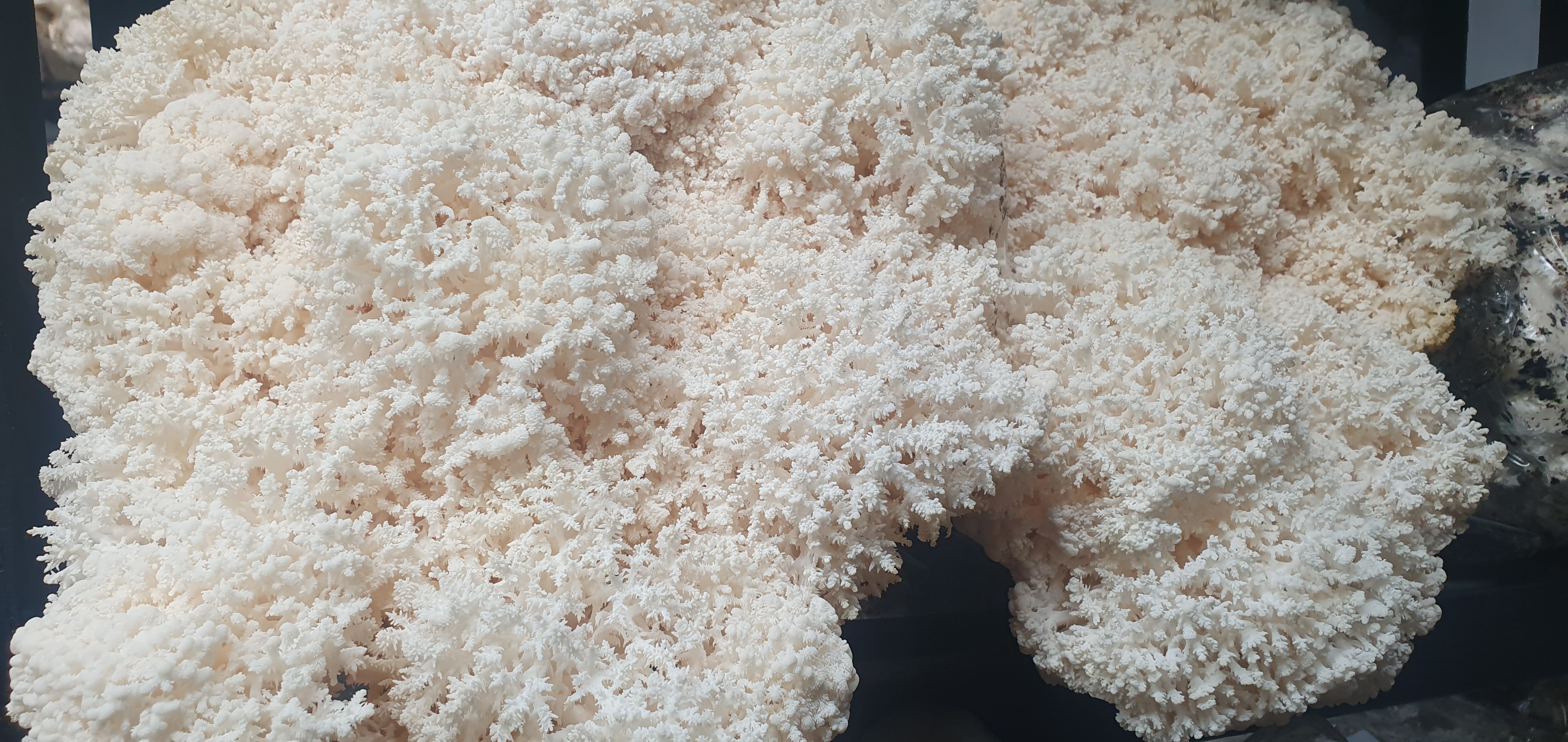
A close relative of Lion's Mane with a branching, coral-like structure and small tooth-like spines along each branch.
Coral Tooth shares Lion’s Mane’s family and its mild, faintly sweet flavour, but grows as a branching, antler-like structure with small spines along each branch rather than one dense mass. It’s a touch more demanding — it notices stale air more quickly, and rewards a slightly more attentive fresh-air routine — which is why it’s marked as moderate rather than beginner difficulty.
Track your Coral Tooth grow
Follow each stage of your grow with timely help, practical advice, and tips for what to do next.
Coral Tooth Grow Kit
Lion's Mane's more intricate cousin — a branching, coral-like cluster for a slightly more attentive grower.
Lead time: 2-4 weeks
The growing journey
Colonizing
The block whitens with mycelium — a little slower than its Lion's Mane relative.
Usually days 1–9
Pinning
Small branching knobs appear, the first hint of the coral-like structure to come.
Usually days 9–12
Rapid Growth
Branches lengthen and spines develop along each one — a slower build than Lion's Mane, but a more intricate result.
Usually days 12–16
Harvest
Harvest once spines have extended and are still white to pale cream.
Usually once spines reach around 1cm and are still pale
Second Flush
A second flush is possible, usually smaller and slower than Lion's Mane's.
Usually 10–16 days after harvest
From growers
Real photos and notes from people growing Coral Tooth, shared from their My Grow dashboard.
Jane, London
Smaller second flush than I hoped for, but still a nice bonus harvest.
Ben, Norwich
Second flush came in almost as big as the first — really happy with this kit.
Lucia, Sheffield
Soaked the block like the guide said and got a smaller but very welcome second flush.
Freya, Brighton
Used a clean knife to cut it free rather than twisting — worked really well.
Noah, Cardiff
Twisted the whole cluster off in one go, exactly like the guide described.
Aisha, Glasgow
Harvested this beauty a day earlier than planned since it looked ready. So glad I didn't wait.
Tom, Leeds
Checking on this daily since it's moving quickly — doubled in size in a couple of days.
Priya, Manchester
Humidity tent seems to be doing its job — really pleased with how full it's looking.
Marcus, Bristol
Growing so fast now — genuinely different every time I check on it.
Ben, Norwich
Pins were a bit slower than I expected, but a bit more humidity got them going.
Lucia, Sheffield
Fanned the opening a few times a day like recommended and pins appeared within days.
Sam, Belfast
First pins showed up right on schedule! Kept it misted twice a day and it took off from here.
Sam, Belfast
Left it alone in a warm cupboard like advised — colonized evenly, no dry patches.
Freya, Brighton
About a week in and the whole block looks solid white now, no odd colours anywhere.
Noah, Cardiff
Substrate's gone fully white and smells earthy — right on track so far.
Common problems
Related guides
How much humidity does my mushroom actually need, and how do I maintain it?
Understanding Humidity
Why humidity matters more than almost anything else in a mushroom grow, and how to keep it steady without guesswork.
Why are my mushrooms growing long, pale stems instead of broad caps?
Fresh Air and Mushroom Shape
Why oyster mushrooms in particular grow long and pale without enough fresh air, and how much airflow is actually enough.
Is the white fuzz on my grow kit mycelium or mould?
Reading White Fuzz
Almost every new grower asks the same question in the first week: is this white fuzz the mushroom, or a mould? Usually, it's mycelium — here's how to tell.
Recipes
Coral Tooth Butter Sauté
A simple butter sauté that lets Coral Tooth's delicate, branching texture speak for itself.
5 minutes prep · 8 minutes cook
Lion's Mane Steaks
Thick-cut, pan-seared Lion's Mane with a golden crust — the simplest way to taste why people compare it to crab.
10 minutes prep · 10 minutes cook
Frequently asked
Is white fuzz on my grow kit normal?
Yes, in almost all cases. White, cottony growth in the first two weeks is mycelium — the mushroom itself — rather than mould. Genuine mould usually shows colour (green, black, pink) rather than staying white. See the full guide on reading white fuzz for the specific signs to watch for.
Can I grow Lion's Mane indoors without special equipment?
Yes — Lion's Mane is one of the more forgiving species for an indoor windowsill or kitchen counter grow. It needs indirect natural light (not direct sun), room temperature, and a humidity bag or tent, but no grow lights or climate control are required for a first kit.